License for traumatic weapons in Ukraine: who is allowed to have one and how to obtain it
11.01.2026Author: Charles Darwin
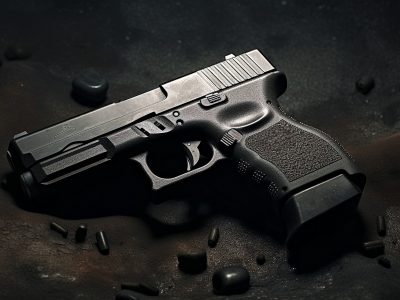
In Ukraine, it is entirely legal to own certain types of civilian weapons, particularly traumatic weapons. These self-defense weapons are considered non-lethal, but if used improperly, they can also cause serious harm. For this reason, the state strictly regulates the acquisition, storage, and carrying of such weapons. Purchasing them without official permission is illegal, and violating established rules entails administrative or criminal liability.
In this article, we will discuss how to obtain a permit for a traumatic weapon, who is eligible, how long it takes, and the cost of registration.
Why do Ukrainians need a permit for a traumatic weapon?
The procedure for acquiring, storing, and using traumatic weapons in Ukraine is determined by Order No. 622 of the Ministry of Internal Affairs of Ukraine dated August 21, 1998. Section II, Chapter 8 of this document provides a list of the types of weapons subject to the mandatory permit system. It states that only pneumatic weapons with a caliber of up to 4.5 mm and a projectile velocity of no more than 100 m/s are permitted to be purchased without special documents.
So, is a permit required for a traumatic weapon in Ukraine? Yes, it is, since it does not fall into the specified category. Possession of a traumatic weapon without the appropriate documents is considered a violation of current legislation. In such cases, administrative sanctions are imposed, and under certain circumstances, criminal liability is also possible.
Who is allowed to own a traumatic weapon in Ukraine?
You’re probably wondering who can obtain a license for a traumatic weapon in Ukraine. Permits to purchase, store, and carry them are issued only to citizens of the country who have reached the age of 21 and who fall into certain categories specified by law. Persons who may apply for a permit include:
representatives of the police, prosecutor’s office, the Security Service of Ukraine, customs and border services, tax authorities, as well as employees of forestry, fisheries protection and other government agencies performing law enforcement functions;
close relatives of law enforcement officers;
members of public formations for the protection of public order and the state border;
military personnel, with the exception of persons performing conscript service;
employees of the judicial system (judges, court secretaries and other officials), as well as participants in criminal proceedings directly involved in trials;
people’s deputies of Ukraine and their assistants;
individual officials holding government positions and holding the appropriate titles or ranks;
journalists and freelancers Correspondents, provided they have official confirmation of their professional status.
Therefore, an ordinary citizen who does not belong to any of the categories stipulated by law cannot obtain a permit for a traumatic weapon in Ukraine. This right is granted exclusively to individuals whose professional activities or legal status involve a high level of risk or the performance of security functions.
In what cases is a permit not issued even with all the necessary documents?
Even if a complete set of documents is submitted, a permit for a traumatic weapon may be denied. Most often, this is due to the fact that the person:
has a criminal record for serious or especially serious crimes;
is on the state wanted list;
has serious medical contraindications confirmed by a medical commission;
submitted invalid or forged documents;
has not reached the legal age.
These grounds are unconditional and are not subject to appeal under the standard permitting procedure.
How long does it take to obtain a traumatic weapon license?
The procedure for registering a traumatic weapon in Ukraine requires obtaining two separate licenses. The first is a permit to purchase a traumatic weapon. An application for this is processed by the territorial offices of the National Police of Ukraine within 30 calendar days.
After receiving the purchase permit, the applicant has up to three months to actually purchase the traumatic pistol. After this, they must reapply to the police for a license to store and carry weapons. This application is typically processed within 15 calendar days.
Therefore, from the time of submitting the initial application to receiving the license to store and carry traumatic weapons, it takes approximately one to two months. The exact timeframe depends on the speed of document processing and the applicant’s activity.
How much does a traumatic weapons permit cost in 2025?
Obtaining a permit involves several mandatory expenses. How much does a license for a non-lethal weapon cost? Let’s calculate it together. First, you must undergo a medical examination and obtain the relevant certificate. Depending on the region and medical facility, this typically costs between 500 and 800 hryvnias.
The next expense is mandatory training in the safe handling of weapons and their equipment. These courses are conducted by accredited organizations, and their cost in 2025 ranges from 1,500 to 2,500 hryvnias. State fees for processing applications are paid separately. A permit to purchase a non-lethal weapon costs 51.9 hryvnias, while a permit to store and carry it costs 54 hryvnias.
Civil liability insurance for the gun owner is also mandatory. Its cost depends on the insurance company and the terms of the contract, but on average it ranges from 300 to 700 hryvnia. Another significant expense is a safe or metal cabinet for storing weapons. The minimum price for simple models starts at around 2,000 hryvnia, while more reliable options can be significantly more expensive.
Step-by-step algorithm: how to obtain a license without unnecessary problems
The procedure for obtaining a license for a traumatic weapon in Ukraine consists of several mandatory steps. Let’s look at each of them in more detail.
Medical examination: which doctors and certificates are required
The first step in obtaining a permit for a traumatic weapon is a mandatory medical examination. This can be completed at a state medical institution or a private clinic with the appropriate license.
The examination involves consultations with several specialized specialists. The applicant must visit:
narcologist;
psychiatrist;
neurologist;
ophthalmologist;
therapist.
After passing the commission, a medical certificate of the established form 127/o is issued, which is valid for one year. To obtain it, you must have a passport and two photographs measuring 3 x 4 cm. Men must also provide a military ID or equivalent document.
Training and knowledge testing
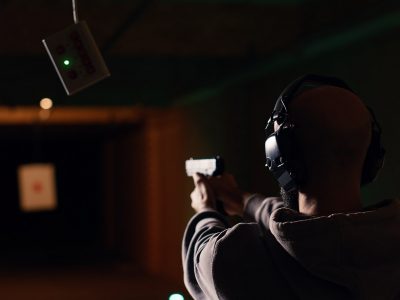
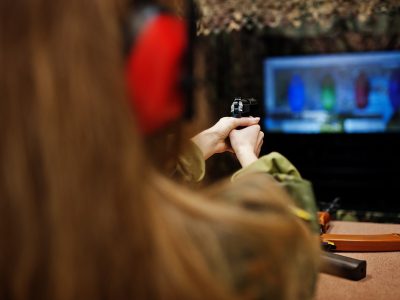
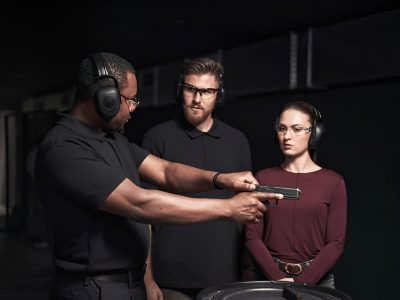
One of the requirements for obtaining a traumatic weapon permit is to undergo special training in the weapon’s hardware and safe handling rules. Such courses are held at certified training centers or shooting ranges in Lviv. Upon completion, you must pass a qualification exam confirming your level of training. Upon successful completion, you will receive a corresponding certificate, which is then submitted to the police department along with the rest of your documents.
Preparing a Storage Area
The next step is equipping a storage area for your traumatic weapon. This requires installing a special gun safe that meets the requirements of the Ministry of Internal Affairs. It must be made of metal, have a secure lock, and be firmly attached to a supporting structure (wall or floor). The safe should be placed in a location where only the gun owner and authorized persons have access.
After installing the safe, it is inspected by a local police officer. Based on the inspection results, a corresponding report is drawn up and a certificate is issued confirming that the storage conditions meet the established requirements.
Submitting an Application and Waiting for a Decision
As already noted, to legally acquire, store, and carry a traumatic pistol in Ukraine, you must obtain two separate licenses. The first is a permit to acquire a weapon, which is obtained before purchase, and the second is a permit to store and carry a pistol, which is obtained after the pistol is purchased. Both procedures are carried out by the territorial divisions of the National Police of Ukraine at the applicant’s place of residence.
What documents are required to obtain a license for a traumatic weapon? The applicant must prepare and submit to the police:
Ukrainian citizen’s passport;
extract from the Register of Territorial Communities (for ID card holders);
identification code;
documents confirming the applicant’s affiliation with persons entitled to own traumatic weapons;
extract of no criminal record;
a photograph measuring 3.5 x 4.5 cm;
medical certificate form 127/o;
certificate of completion of training on the material part of weapons and the rules for safe handling;
report of the district police officer on the inspection of the storage location weapons;
receipt of payment of state fee;
application for permit renewal.
If the owner fails to submit documents for license renewal within the prescribed period, it is considered expired and invalid. In such a situation, the National Police has the right to revoke the documents and require the surrender of the non-lethal weapon until the permit is reissued.
What is the penalty for possessing a non-lethal weapon without a license?
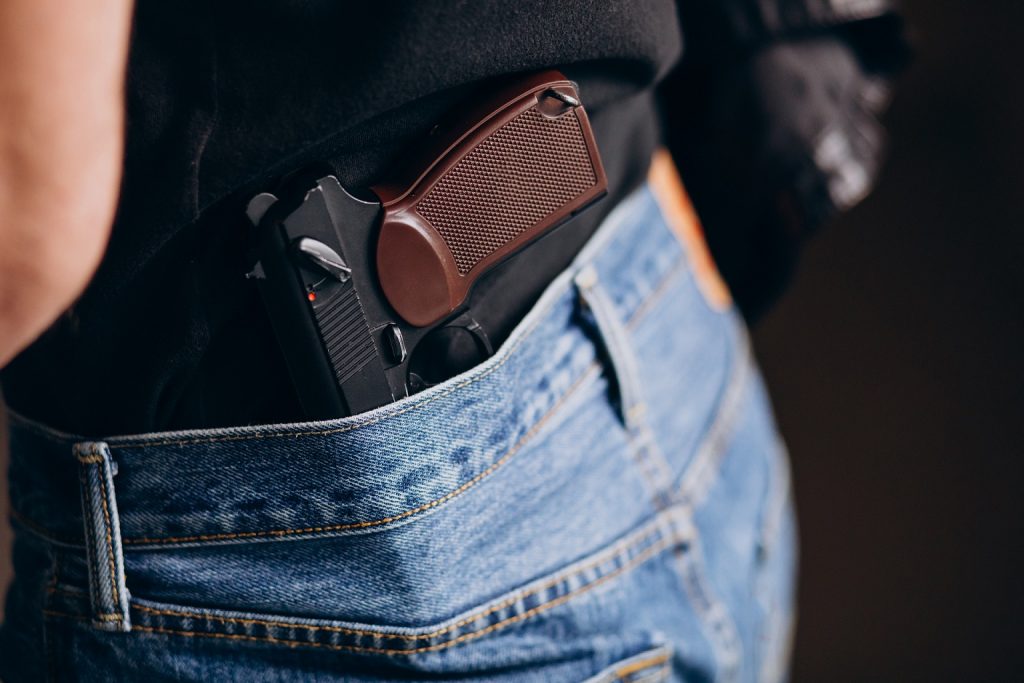
Possession of a non-lethal weapon without a valid permit in Ukraine is considered a violation of the law and can have serious legal consequences. Depending on the circumstances of the case, the individual may be subject to administrative or criminal liability.
Handsome man actor posing in studio with weapon
Administrative liability applies in cases where the violation does not constitute a criminal offense. According to the Code of Ukraine on Administrative Offenses, illegal possession or carrying of traumatic weapons without proper permission may result in a fine of 7-14 times the non-taxable minimum income. In addition to the fine, the law also provides for possible confiscation of the weapon.
Criminal liability applies in more serious cases, for example, if the illegal possession, transportation, or sale of traumatic weapons is accompanied by aggravating circumstances, repeated violations, or the actual use of the weapon. In such situations, according to Article 263 of the Criminal Code of Ukraine, an individual may face imprisonment for a term of 3 to 7 years, a fine of up to 2,000 non-taxable minimum incomes, or correctional labor for up to two years. At the same time, the law provides for the possibility of exemption from criminal liability if a person voluntarily surrenders a weapon to the police before the pre-trial investigation begins.
In addition to the basic sanctions, additional measures may be applied to the offender, including:
confiscation of the weapon without the right to return it;
administrative arrest for up to 15 days;
restriction or complete ban on obtaining future weapons permits.
Therefore, if you plan to own a traumatic weapon and are legally permitted to do so, the only correct course of action is to obtain all the necessary documents. This will protect you from serious legal consequences.
The Most Common Myths and Mistakes of Beginners
Despite clearly defined regulations, many misconceptions still exist surrounding traumatic weapons in Ukraine. Some of them arise from a misunderstanding of the law. These myths most often result in fines and serious legal problems. Therefore, we would like to examine the most common ones and explain why they are completely unfounded:
“Once you get it, you’re good to go.” A permit to possess and carry a traumatic weapon is issued for a limited period (3 years) and is subject to mandatory renewal.
“Permits are not required for self-defense.” The law makes no exceptions even for such a motive as self-defense. Regardless of the purpose of use, a traumatic weapon requires a license.
“A traumatic weapon is not a real weapon, so there are no strict rules.” Although such weapons are considered non-lethal, they are officially classified as civilian firearms of limited action.
“A permit is only required for purchase, not for carrying.” In fact, the permitting procedure consists of two stages. First, you need to obtain a license to purchase a traumatic weapon, and then to store and carry it.
“If the weapon is at home, there is no liability.” Each traumatic weapon must be licensed, regardless of where it is stored.
“If the weapon is not registered in my name, I am not responsible.” Actual possession or carrying of a weapon without a permit is grounds for prosecution, regardless of who it is registered to.
“Trauma can be transferred to relatives or friends.” Transferring a traumatic weapon to another person, even a close relative, is prohibited. Only the person in whose name the permit is issued has the right to use it.
These erroneous opinions often lead to fines, confiscation of weapons, or even criminal liability. Therefore, it is worth remembering that in Ukraine, there are no traumatic weapons that do not require a permit. If you want to become its owner, be guided not by rumors, but by legal requirements.
More on this topic
09.12.2025
How to hold a pistol correctly
Whether you're training at the range, practicing target shooting, or mastering basic self-defense skills, the way you hold your pistol directly affects your shot accuracy, gun control, and your safety. An incorrect grip can lead not only to missed shots but also to injury, especially when handling h
01.12.2025
Delays during shooting: main causes and ways to eliminate them
With proper handling and maintenance, a firearm's components and mechanisms can operate reliably for many years. However, even the most reliable systems are not immune to malfunctions. Delays during firing can occur due to contamination, wear, improper maintenance, or the use of low-quality ammuniti
25.11.2025
Handling weapons: basic safety and shooting techniques
Using a firearm always carries risk. That's why anyone who picks up a pistol or shotgun must follow simple yet critical rules to avoid endangering themselves and others. This article summarizes the basic principles of firearms safety. These are skills every shooter should master until they become se
09.12.2025
How to hold a pistol correctly
Whether you're training at the range, practicing target shooting, or mastering basic self-defense skills, the way you hold your pistol directly affects your shot accuracy, gun control, and your safety. An incorrect grip can lead not only to missed shots but also to injury, especially when handling h
01.12.2025
Delays during shooting: main causes and ways to eliminate them
With proper handling and maintenance, a firearm's components and mechanisms can operate reliably for many years. However, even the most reliable systems are not immune to malfunctions. Delays during firing can occur due to contamination, wear, improper maintenance, or the use of low-quality ammuniti
25.11.2025
Handling weapons: basic safety and shooting techniques
Using a firearm always carries risk. That's why anyone who picks up a pistol or shotgun must follow simple yet critical rules to avoid endangering themselves and others. This article summarizes the basic principles of firearms safety. These are skills every shooter should master until they become se