How active shooting headphones work and what to consider when choosing
11.01.2026Author: Charles Darwin
During a gunshot, noise levels can exceed 140-160 dB, while explosions or heavy weapons create extremely strong acoustic loads that can damage the eardrum. Without proper protection, such sounds can cause microtrauma, decreased sensitivity, and irreversible hearing damage.
Personal protective equipment has been developed to minimize these risks. Active earmuffs are considered the most effective. Unlike passive models, they don’t simply isolate noise; they analyze the surrounding soundscape, automatically attenuate dangerous peaks, and simultaneously amplify important signals (voice, commands, footsteps).
In this article, we will explain in detail how active earmuffs work and how they implement active noise cancellation. You will also learn which characteristics are key when choosing personal hearing protection for shooting ranges or military applications.
What Happens to Hearing During a Gunshot
A gunshot is a short but extremely intense pulsed noise that exceeds the safe threshold for human hearing. The sound wave from a rifle or pistol reaches 140-160 dB, and in enclosed spaces, this figure increases significantly. This level of pressure on the hearing system is critical, as the hearing organs are physically unable to adapt or compensate for the shock wave. Based on this, the following processes occur during a gunshot:
The acoustic shock wave causes a sharp positive and then negative pressure fluctuation in the external auditory canal.
The eardrum is subjected to vibrations with an amplitude of up to several millimeters.
The chain of auditory ossicles (malleus, incus, and stapes) transmits the shock from the eardrum to the inner ear.
A powerful hydrodynamic shock wave is generated in the perilymph of the cochlea, causing excessive displacement of the basilar membrane.
The hair cells of the organ of Corti are subjected to mechanical deformation and the detachment of stereocilia from the tectorial membrane.
All this leads to the development of acoustic trauma to the ear. It can be acute (occurs with exposure to very intense noise of 120-130 dB and above) or chronic (develops as a result of prolonged exposure to noise of average intensity of 80-90 dB).
Symptoms of acute acoustic trauma include:
sudden sharp hearing loss or complete loss of perception of surrounding sounds;
ear pain;
the appearance of a ringing or squeaking sound;
dizziness;
bleeding from the ear (in case of a ruptured eardrum).
Chronic acoustic trauma is accompanied by:
background noise or ringing in the ears;
gradual or significant decrease Hearing;
Eardrum retraction.
A gunshot lasts a split second, but its effects are cumulative. That’s why wearing earmuffs while shooting is not a recommendation, but a mandatory rule.
How Active Earmuffs Work
Active earmuffs for shooting are electronic hearing protection devices that selectively reduce dangerous peak pulses while simultaneously transmitting or amplifying useful signals. They work as follows:
The headphones’ external microphones record all surrounding sounds.
A digital signal processor (DSP) analyzes the received signal and determines its volume.
The processor limits the peak amplitude of noise exceeding a safe threshold (approximately 82-85 dB).
Quiet sounds (commands, footsteps, speech) are amplified so the user can hear them even in a noisy environment.
The processed sound is transmitted to the headphones’ internal speakers without noticeable latency (usually
As a result, active headphones protect the shooter’s hearing and also allow him to monitor his surroundings and navigate in space.
What is active noise cancellation and how is it implemented?
Active noise cancellation (ANC) This is a technology that neutralizes dangerous sound peaks using antisound. The method involves the headphones’ electronics generating a wave that is in opposite phase to the gunshot noise. When the two waves overlap, some of the pressure is canceled out, making the sound significantly quieter and safer for hearing.
Unlike consumer ANC headphones, which attenuate uniform background noise from equipment, shooting models handle sharp, ultra-high-volume peaks. Therefore, their electronics are significantly more powerful.
Important Components of Active Hearing Protection
Active headphones consist of many structural components. Their quality determines how well the device filters out dangerous noise and amplifies useful signals.
Ear Pads and Cup Shape
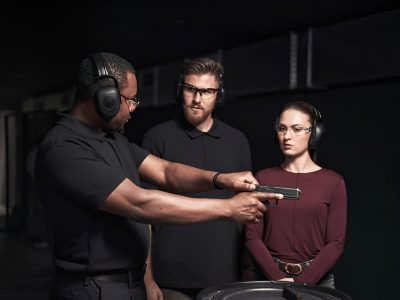
The ear pads of active headphones provide primary passive isolation. They must fit tightly to your head, as even a small gap dramatically reduces protection and impairs electronic performance.
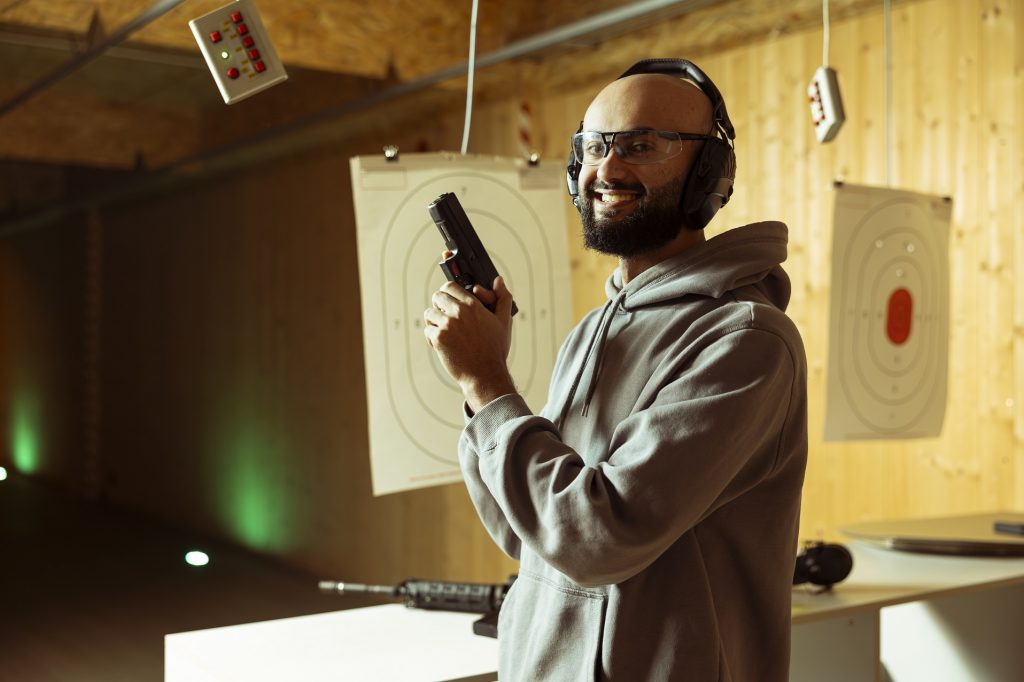
Portrait of happy Arab man in shooting gallery doing training, learning firearm safety and proper gun handling. Smiling Middle Eastern person practicing with pistol, wearing safety glasses
There are two main types of active headphone ear pads:
Gel. These provide the best seal and maximum comfort over long periods of use. Gel evenly distributes pressure and adapts to the shape of your head, and also returns to its original shape well, making these ear pads more durable.
Foam. These are lighter and less expensive, but can lose their shape over time. This gradually reduces the seal and noise-canceling effectiveness, so they need to be replaced periodically.
The shape of the ear cups in active headphones can also vary. Low-profile models are more comfortable for shooting a rifle or shotgun because they don’t interfere with the buttstock. Larger earcups provide better passive isolation but may not be compatible with glasses or other protective equipment.
Microphones
The external microphones of active headphones are responsible for capturing ambient sounds and transmitting them to a digital processor for processing. Models with a dual stereo microphone system (two on each earcup) are considered the optimal choice. This configuration improves the shooter’s spatial orientation, allowing them to more accurately pinpoint the direction of the sound source.
Microphones in active headphones must meet several key requirements:
Wide frequency range. Ensures accurate pickup of both quiet sounds and sharp impulse noise.
Wind and dust protection. Pads and filters prevent contamination of the microphones and unwanted distortion, especially when using headphones outdoors.
Correct placement on the housing. Microphones should not be obstructed by helmets, belts, collars, or other equipment.
Electronic Signal Processing Unit
The digital signal processor (DSP) is the core and most important component of active headphones. It analyzes sound in real time, determines its intensity, and instantly responds to dangerous impulses.
Depending on the model, the DSP can operate in one or both of the following main modes:
Peak clipping. When the noise level exceeds 82-85 dB, the active headphone processor instantly reduces its amplitude, preventing shock waves from reaching the ear.
Dynamic compression. Instead of completely muting loud sounds, the processor reduces them to a safe level and amplifies quiet signals. This allows you to hear commands and surrounding sounds even when gunfire is nearby.
In addition, modern active headphone processors can filter low-frequency background noise (wind, machinery, traffic), separately amplify the range of human speech, and equalize volume.
A high-quality DSP should respond with maximum speed. The typical delay is thousandths of a second, which virtually eliminates the risk of acoustic trauma.
Power Type and Battery Life
Active headphones can have the following power types:
Replaceable AA/AAA batteries. High-quality models operate for tens to hundreds of hours on a single charge, making this type of power supply extremely reliable in the field. Furthermore, batteries can be quickly and easily replaced if necessary.
Built-in batteries. They are charged via USB or special docking stations. These active headphones are suitable for regular training at shooting ranges and everyday use.
Combined Systems. These models can operate with either a built-in rechargeable battery or standard batteries.
Some models of active headphones are equipped with additional, very useful features. These include automatic shut-off, which prevents accidental discharge, and a battery level indicator.
What tasks are active headphones best suited for?
Active headphones are ideal for situations where both hearing protection and situational awareness are important. They are effective in a wide range of applications:
Sport and practical shooting. Active headphones muffle the impulse noise of gunfire. At the same time, the shooter clearly hears instructor commands, timer signals, and the movement of participants, which is especially important in dynamic disciplines.
Military training and combat missions. During training and actual operations, active hearing protection protects against explosions and gunfire while ensuring clear transmission of voice commands. This improves reaction time, reduces risks, and allows soldiers to fully monitor the situation on the ground.
Hunting. Using active hearing protection, a hunter can hear rustling leaves, animal movements, cracking branches, and other ambient sounds. Gunshots are muffled to a safe level.
Furthermore, active hearing protection is often used in construction and manufacturing. They prevent acoustic trauma while simultaneously helping to hear important safety signals, coworkers’ voices, and the sounds of machinery, reducing the risk of accidents.
How to Choose Active Earmuffs for Shooting and Military Tasks
Before choosing active hearing protection for shooting or military tasks, it’s important to consider their technical specifications. Key features to consider before purchasing include:
Active Noise Reduction Rating (NRR/SNR). This is one of the main indicators of hearing protection effectiveness. The higher the NRR, the better the headphones suppress dangerous impulse noise. A level of 22 dB or higher is considered acceptable for shooting, while for high-powered calibers and military applications, it is advisable to choose models with the highest possible NRR.
Processor Response Speed. In shooting and tactical situations, it is critical that headphones limit impulse noise instantly. A response time of approximately 0.001 ms is considered optimal.
Number and Microphone Placement. For high-quality spatial awareness, especially in military and tactical scenarios, it is worth choosing active headphones with a dual stereo microphone system (two per ear cup). This allows for more accurate sound direction determination and maintains situational awareness.
Ergonomics and Comfort. Headphones should fit comfortably, without putting pressure on your head or causing fatigue, even with prolonged use. Consider the quality of the ear pads, the presence of an adjustable headband, and the overall weight of the design. Lighter models are better suited for dynamic activities or multi-hour training sessions.
For military and tactical applications, it’s critical that active headphones are compatible with your gear (helmet, goggles, mask, etc.). You should also check for radio ports, integration with communication systems, Bluetooth, or other additional features if needed for your use case.
Active headphones weren’t created without a reason. They’re a key safety device that protects one of your most vulnerable senses. The sound of a gunshot lasts a split second, but its effects can stay with you for life. That’s why active headphones should be a mandatory part of your gear, whether you’re shooting at a shooting range, on a firing range, or performing tactical missions.
More on this topic
02.12.2025
What are tactical eyepieces and why are stinks needed?
Tactical glasses are an essential piece of protective gear for military personnel, special forces, shooters, hunters, and anyone working in high-risk environments. They are designed to protect the eyes from shrapnel, shell casings, dust, ultraviolet radiation, chemicals, and hazardous mechanical imp
26.11.2025
How to aim correctly at a shooting range
An accurate shot begins not with pulling the trigger, but with proper aim. Everything matters—grip, stance, breathing, and, most importantly, the ability to properly operate the sights. These skills must be constantly practiced. Only then will every bullet fly right to the center of the target.
I
25.11.2025
Handling weapons: basic safety and shooting techniques
Using a firearm always carries risk. That's why anyone who picks up a pistol or shotgun must follow simple yet critical rules to avoid endangering themselves and others. This article summarizes the basic principles of firearms safety. These are skills every shooter should master until they become se
02.12.2025
What are tactical eyepieces and why are stinks needed?
Tactical glasses are an essential piece of protective gear for military personnel, special forces, shooters, hunters, and anyone working in high-risk environments. They are designed to protect the eyes from shrapnel, shell casings, dust, ultraviolet radiation, chemicals, and hazardous mechanical imp
26.11.2025
How to aim correctly at a shooting range
An accurate shot begins not with pulling the trigger, but with proper aim. Everything matters—grip, stance, breathing, and, most importantly, the ability to properly operate the sights. These skills must be constantly practiced. Only then will every bullet fly right to the center of the target.
I
25.11.2025
Handling weapons: basic safety and shooting techniques
Using a firearm always carries risk. That's why anyone who picks up a pistol or shotgun must follow simple yet critical rules to avoid endangering themselves and others. This article summarizes the basic principles of firearms safety. These are skills every shooter should master until they become se