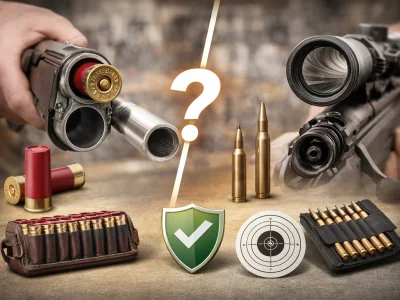
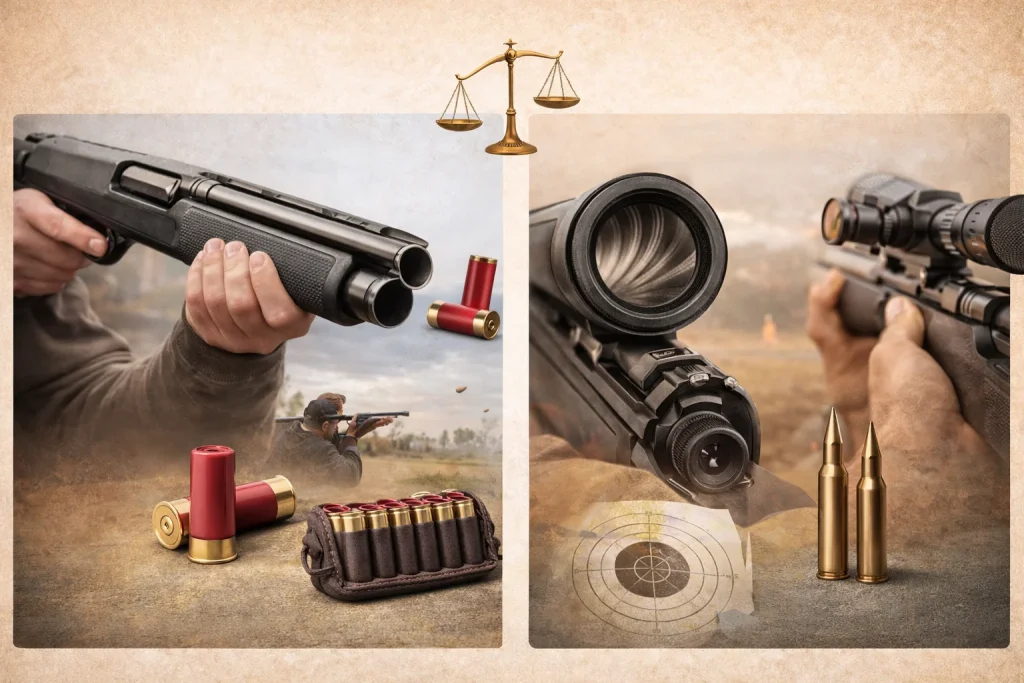
When choosing a first shotgun, every shooter inevitably faces a dilemma: should they settle on a time-tested smoothbore model or opt for a more complex and accurate rifled model? At first glance, this question seems complicated, as each type has its own advantages. However, understanding the technical features and operating principles of each type of gun will make making the right choice much easier.
In this article, we’ll examine the differences between smoothbore and rifled guns, explain how barrel design affects the shot, and help you determine which option is optimal for your needs and conditions.
Barrel Anatomy: How Rifling and the Absence of Rifling Affect the Physics of a Shot
The fundamental difference between smoothbore and rifled guns is hidden within the bore. Its internal geometry determines how the bullet behaves after the propellant gases expel it.
The bore of a smoothbore gun has simple geometry. It is a smooth cylinder, sometimes ending in a constriction (choke) to control the dispersion of the pellets. During firing, the projectile (bullet, shot, or buckshot) moves down the barrel under the action of the propellant gases without any forced rotation. In this system, the bullet is stabilized primarily by its shape and mass, rather than by gyroscopic effects. This lack of rotation makes it possible to use shotshells in smoothbore guns, which disperse and create a larger kill zone after exiting the barrel. At the same time, a bullet fired from a smoothbore gun lacks sufficient stabilization in flight, so its trajectory quickly becomes unpredictable, and accuracy noticeably decreases after approximately 50-70 meters.
A rifled barrel has spiral grooves – rifling – running its entire length. When fired, the bullet, whose diameter slightly exceeds the bore diameter, enters these grooves and begins to spin around its axis. Upon exiting the barrel, it not only has high forward velocity but also significant angular velocity. This creates a gyroscopic effect – the same principle that prevents a spinning top from falling over. This allows the bullet to maintain its orientation in flight, moving forward with its nose, and being significantly less sensitive to air disturbances. This ensures high shooting accuracy and allows targets to be hit at ranges of 300+ meters.
Smoothbore Weapon Capabilities: From Versatility to Stopping Power
Smoothbore weapons remain one of the most versatile and practical weapons. This is not surprising, as it offers the following advantages:
a simple and reliable design, especially in pump-action and semi-automatic systems, which operates reliably even in difficult conditions;
high stopping power at short and medium ranges due to the large projectile mass or dense pellet dispersion;
a wide kill zone, which partially compensates for aiming errors and improves shooting effectiveness in dynamic situations;
the availability of both the weapon itself and ammunition, making it a popular choice for a wide range of users;
a wide range of applications, as this weapon is suitable for hunting, target practice, and self-defense.
The versatility of smoothbore weapons is especially noteworthy. A single gun can fire various types of ammunition – shot, buckshot, slugs, as well as special charges (flare, gas, or traumatic).
Effective Shot with Shot and Buckshot at Close Range
Shot and buckshot are most often used with smoothbore weapons, as these types of ammunition maximize their potential at short and medium ranges.
Small shot (from #7 to #12) forms a spray of shot when fired from the muzzle – a controlled dispersion cone. The result is a dense and uniform scattering pattern, providing a wide kill zone and significantly increasing the likelihood of hitting small, moving targets. It is this ballistic characteristic that makes small shot an optimal choice for clay pigeon shooting and feathered game hunting. Medium and large shot (from #4 to #1) have a greater mass of individual particles, which allows for greater kinetic energy retention and effective performance against medium-sized game, as well as in short-range practical scenarios.
Buckshot significantly changes the impact of a shot. Unlike shot, it consists of a limited number of massive projectiles that travel in a more compact group and retain significant energy over distance. At a range of approximately 10-35 meters, this cartridge exhibits high stopping power. This makes it an effective solution for close-range work, particularly in practical scenarios or when hunting big game in confined spaces.
Advantages of Rifles: Accuracy and Stability at Long Range
While smoothbore guns are associated with versatility at close range, rifles are tools designed to ensure maximum accuracy at significant distances. Its main advantages:
high shooting accuracy even at significant distances;
projectile flight stability thanks to gyroscopic stabilization;
high penetration and stopping power at medium and long ranges;
wide range of application.
These characteristics are achieved through a fundamentally different approach to bullet stabilization in flight.
The Effect of Bullet Spin on Ballistics and Firing Accuracy
The key advantage of rifled weapons is their ability to stabilize the bullet in flight by rapidly spinning it around its own axis. As the bullet passes through the barrel’s helical rifling, it acquires significant angular velocity, creating a gyroscopic effect. This effect allows it to maintain a stable nose-first orientation throughout its flight and effectively counteract aerodynamic drag.
Unlike smoothbore weapons, where stabilization is limited by the projectile’s shape, rifled weapons demonstrate significantly higher accuracy and trajectory predictability. Gyroscopic stabilization minimizes the influence of random factors, allowing for tight groupings even at long ranges. Furthermore, due to the higher muzzle velocity and improved ballistic coefficient, the bullet’s trajectory is more inclined, improving firing efficiency.
Stable spin also contributes to energy conservation. The bullet maintains its velocity longer in flight, which directly impacts its penetrating and damaging power. This allows it to be effective at ranges of 300, 500, and more meters.
Ballistics Comparison: Flight Trajectory and Penetration
The ballistic profile of a shot is the main criterion determining a weapon’s effectiveness in real-world conditions. The difference in ballistics between smoothbore and rifled weapons is due to the muzzle velocity and aerodynamic stability of the projectile itself.
Rifled weapons have a longer range – the bullet’s ability to fly along a very flat trajectory. Due to its high muzzle velocity and low aerodynamic drag, a rifled shotgun bullet maintains its altitude significantly longer.
At the same time, a bullet fired from a smoothbore gun has a low ballistic coefficient and loses velocity quickly. Its trajectory resembles a steep arc, where after 50 meters the drop becomes significant. This makes a smoothbore weapon ideal for fast shooting at short ranges, where ballistic drop is negligible.
Regarding penetration, when fired from a smoothbore weapon, the cartridge possesses colossal energy at the start. A heavy 12-gauge bullet demonstrates incredible stopping power at short range. However, due to its large cross-sectional area, it is quickly decelerated by air, and its penetration drops off rapidly with each meter.
Rifled weapons operate on a different principle. The bullet has a smaller diameter relative to its mass, a higher muzzle velocity, and better aerodynamic properties. This allows it to lose speed more slowly in flight. Furthermore, gyroscopic stabilization allows the bullet to maintain its correct orientation, which directly impacts the effectiveness of target penetration. As a result, a cartridge fired from a rifled barrel retains sufficient energy to confidently hit a target even at distances of half a kilometer.
Practical Applications: When Smoothbore and Rifled Guns Work Better
The choice between a smoothbore and rifled gun always depends on the distance, target type, and conditions of use. Each system has its own effective zone, where its technical advantages are fully realized.
A smoothbore gun is a weapon designed for shooting at short distances, typically up to 50 meters. It is ideal for the following tasks:
Regular and driven hunts. In difficult conditions (dense thickets, forests, rough terrain with limited visibility), a smoothbore gun allows the shooter to react instantly and fire an accurate shot at a moving target.
Self-defense and property protection. At close range, smoothbore weapons demonstrate the highest stopping power. Pump-action and semi-automatic systems are the benchmark for reliability, combining high firepower with the ability to quickly repeat shots.
Sports and training. Smoothbore weapons are the primary tool for classical disciplines (trap, skeet, sporting) and dynamic practical shooting (IPSC). Here, reaction speed, coordination, and firing skills are paramount.
Recreational shooting. Using smoothbore weapons at shooting ranges allows you to practice basic shooting skills with various types of ammunition.
Rifled rifles become effective where smoothbore weapons fail. These are weapons for open spaces and precise calculations. It is ideal for the following tasks:
high-precision shooting at distances of 100, 300, 500 meters and more;
open-air hunting, where the target is a significant distance from the shooter;
tactical and sport training, where optics, distances, and ballistic corrections are practiced.
Rifled weapons are a reliable tool for tasks where accuracy, predictability, and shooting range are key.
Conclusion: Which weapon should you choose based on your technical needs?
Let’s summarize: which is better – a rifled or a smoothbore weapon? There is no definitive answer to this question, as there is no universal “one-size-fits-all” system. There’s only one weapon that best suits your needs.
Choose a smoothbore gun if your priorities are versatility, close-range shooting, and performance. It’s the ideal choice for self-defense, bird hunting, training, and sporting events.
If accuracy, trajectory control, and long-range shooting are your priorities, then a rifled gun is the way to go. It requires more training and an understanding of ballistics, but it delivers consistent and predictable results where a smoothbore gun is ineffective.
However, remember that theory is just the foundation. You can truly understand the difference between a smoothbore and a rifled gun only at the shooting range. You can try out both types of guns at our shooting club in Lviv. This will allow you to make a choice based on your own feelings and real results, rather than on numbers from catalogs.
More on this topic
11.03.2026
The difference between a magazine and a clip
In shooting terminology, the words «magazine» and «clip» are often used as synonyms. In fact, these are two fundamentally different elements that perform different functions in the process of loading a firearm. Every shooter should understand the difference between these concepts, because it is as b
09.12.2025
How to hold a pistol correctly
Whether you're training at the range, practicing target shooting, or mastering basic self-defense skills, the way you hold your pistol directly affects your shot accuracy, gun control, and your safety. An incorrect grip can lead not only to missed shots but also to injury, especially when handling h
05.04.2026
Airgun Permits: Are They Required and How to Obtain One
Air pistols and rifles are often perceived as frivolous weapons, as there's a common misconception that purchasing them doesn't require a permit. However, in practice, things are not so clear-cut. In Ukraine, the circulation of such weapons is partially regulated by law, and in some cases, they are
11.03.2026
The difference between a magazine and a clip
In shooting terminology, the words «magazine» and «clip» are often used as synonyms. In fact, these are two fundamentally different elements that perform different functions in the process of loading a firearm. Every shooter should understand the difference between these concepts, because it is as b
09.12.2025
How to hold a pistol correctly
Whether you're training at the range, practicing target shooting, or mastering basic self-defense skills, the way you hold your pistol directly affects your shot accuracy, gun control, and your safety. An incorrect grip can lead not only to missed shots but also to injury, especially when handling h
05.04.2026
Airgun Permits: Are They Required and How to Obtain One
Air pistols and rifles are often perceived as frivolous weapons, as there's a common misconception that purchasing them doesn't require a permit. However, in practice, things are not so clear-cut. In Ukraine, the circulation of such weapons is partially regulated by law, and in some cases, they are