Red dot sight vs. optical sight: comparison, advantages and disadvantages
05.05.2026Author: Charles Darwin
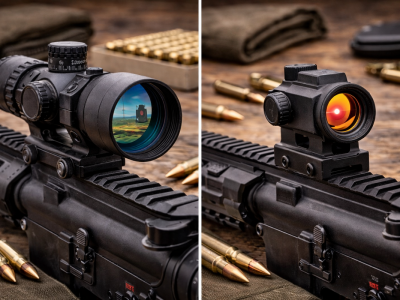
The choice of sight directly affects the speed of target acquisition, shot accuracy, and ease of use. Most often, shooters choose between two types of such devices: collimator and optical.
A collimator is suitable for quickly acquiring a target at short and medium ranges, while an optical sight is used for more accurate shooting at longer distances. These devices have different operating principles, purposes, and their own advantages and disadvantages. All of this must be taken into account when choosing one.
In this article, we will examine the main differences between collimator and optical sights, discuss their features, and help you decide which option is best for your needs.
Main Differences Between Optics and Collimators
The main difference between optical and collimator sights lies in their operating principle and purpose.
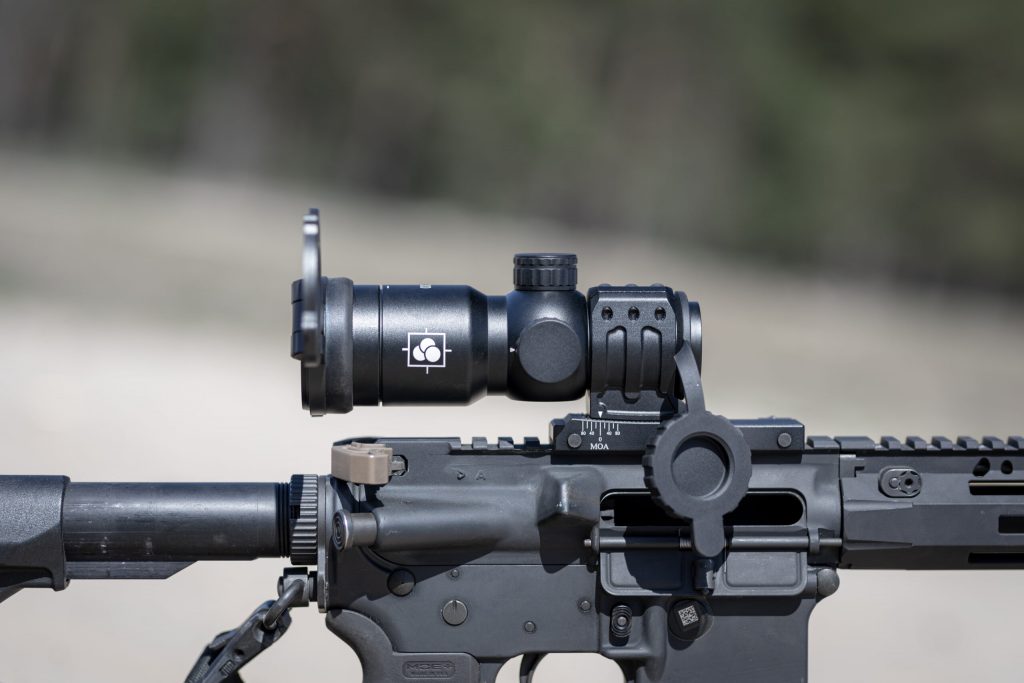
An optical sight operates like a telescope. A lens system that magnifies the target’s image, as well as a reticle, is located inside the scope. Magnification can be fixed or variable. How do you use a scope? To use this type of device, the shooter must correctly set the distance from the eye to the eyepiece, adjust the image clarity, and align the reticle with the target.
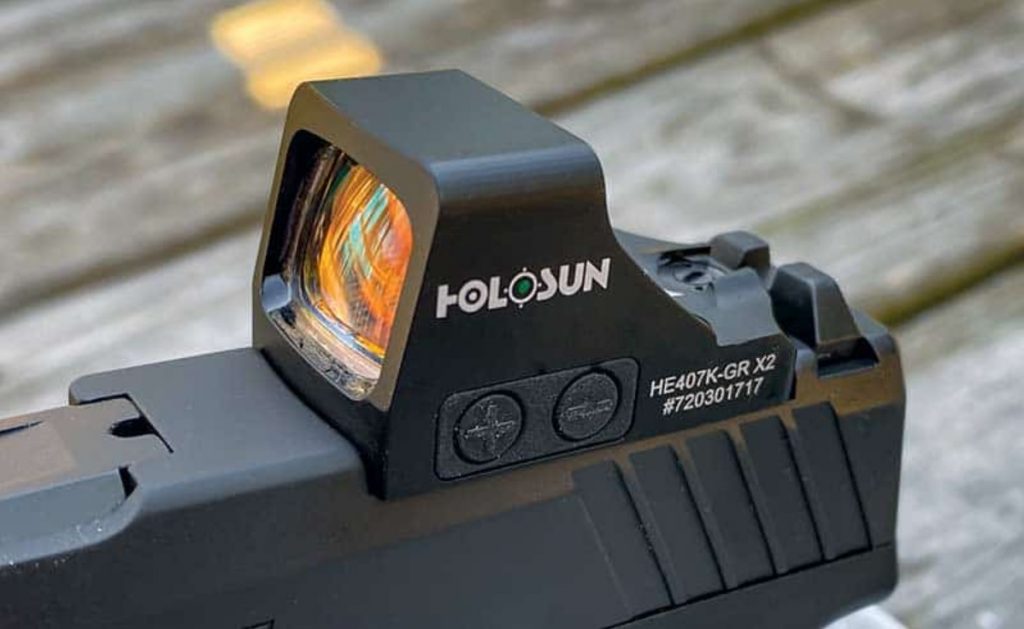
A red dot sight operates on a different principle. It does not magnify the image and does not have a traditional reticle. It operates by projecting a light mark that the shooter sees in the field of view. How do you properly aim a rifle with a red dot sight? To fire, simply align the reticle with the target and pull the trigger. Unlike optics, a red dot sight does not require precise eye positioning relative to the scope, as it is virtually independent of the shooter’s head position. This significantly speeds up the aiming process.
Riflescopes are used where accuracy at medium and long ranges is important. Collimators are suitable for close-range and dynamic situations where reaction speed is crucial.
Reflex Sight: Characteristics and Purpose
To better understand the capabilities of a reflex sight, it’s worth considering where exactly it’s used in practice, as well as understanding the strengths and weaknesses of this device.
In what situations is a reflex sight used?
Reflex sights perform best at close and medium ranges (usually up to 100-150 meters). It is ideal for:
The red dot sight has a number of advantages, making it widely used in shooting practice. These include:
high aiming speed (just align the reticle with the target);
wide field of view and the ability to operate with eyes open;
no rigid attachment to head position when aiming;
compact size and light weight;
good reticle visibility in varying lighting conditions (in models with adjustable brightness).
At the same time, such scopes also have certain disadvantages that should be considered before choosing them:
the lack of magnification reduces the device’s effectiveness at medium and long distances;
dependence on a power source;
sensitivity to damage to the optical element;
reticle visibility may be reduced in bright light (in models without brightness adjustment).
Optical Sight: Features and Applications
To objectively evaluate the capabilities of an optical sight, it is important to understand the conditions under which it performs best, as well as its advantages and disadvantages in practical use.
When is an optical sight used?
An optical sight performs best in applications requiring high accuracy at long ranges. That’s why its main applications include:
Hunting medium and large game (roe deer, wild boar, deer, elk);
Sport shooting at long range (benchrest, PRS, F-Class);
Tactical and sniper shooting;
Training at distances of 100 meters or more.
An optical sight is especially effective when shooting from a rest or a prepared position, where you have complete control over the aiming process.
Advantages and Disadvantages
An optical sight has a number of significant advantages. These include:
magnification, allowing for clear target identification at long ranges;
better target visibility at dusk and in low light (in models with high-quality lighting);
reticle with adjustments for distance and wind;
high accuracy at medium and long ranges.
At the same time, optical sights also have certain disadvantages. These include:
a narrower field of view compared to a red dot sight;
large dimensions and weight;
slow aiming, especially at moving targets;
requirements for proper fit and adjustments (eye distance, diopter adjustment).
Key factors when choosing a sight
When choosing between an optical sight and a red dot sight, it’s important to consider the conditions in which you plan to use the weapon. Let’s look at the main factors that will help you make the right decision:
Shooting range. For close range, a red dot sight is the optimal choice. If shooting at medium or long ranges, it’s better to choose an optical sight with the appropriate magnification.
Shooting style. If you shoot at moving targets, in dynamic situations, or in situations that require a quick change of fire, a red dot sight is a good choice. For accurate shooting at stationary targets at a distance, an optical sight is preferable.
Weapon type. A red dot sight works well with assault rifles, carbines, shotguns, and pistols. Optical sights are most often installed on hunting or sniper rifles.
As you can see, there is no definitive answer to the question of which is better—a red dot sight or an optical sight. Both devices have their strengths, so the decision should be made not based on “better or worse,” but rather based on your own needs and usage scenarios. That’s why, before purchasing a sight, always consider the conditions in which you plan to use the weapon and determine what is more important to you—red dot sights. aiming speed or accuracy at range.
Also, remember that after installing the scope, it is imperative to zero in the weapon. This will allow you to align the aiming point with the actual point of impact of the bullet.
More on this topic
09.12.2025
Tactical Gloves: A Complete Guide to Sizing and Choosing the Right Glove
Tactical gloves are an essential piece of equipment for special forces, law enforcement, military personnel, hunters, shooters, and anyone whose work involves intense physical activity. They protect hands, provide a secure grip, absorb shock, and allow you to work confidently even in difficult or ex
11.03.2026
The difference between a magazine and a clip
In shooting terminology, the words «magazine» and «clip» are often used as synonyms. In fact, these are two fundamentally different elements that perform different functions in the process of loading a firearm. Every shooter should understand the difference between these concepts, because it is as b
09.12.2025
Tactical Gloves: A Complete Guide to Sizing and Choosing the Right Glove
Tactical gloves are an essential piece of equipment for special forces, law enforcement, military personnel, hunters, shooters, and anyone whose work involves intense physical activity. They protect hands, provide a secure grip, absorb shock, and allow you to work confidently even in difficult or ex
11.03.2026
The difference between a magazine and a clip
In shooting terminology, the words «magazine» and «clip» are often used as synonyms. In fact, these are two fundamentally different elements that perform different functions in the process of loading a firearm. Every shooter should understand the difference between these concepts, because it is as b