Shooting accuracy is not only a matter of successfully mastered skill, but the result of properly adjusting the entire shooting system. Even high-quality weapons and ammunition alone do not guarantee consistent hits. This is precisely why zeroing is necessary — it’s a mandatory step in preparing a combat unit for use.
Properly performed zeroing allows you to understand the behavior of the weapon, ammunition, and sights as a single mechanism, and also ensures reproducible accuracy in real-world conditions.
In this article, we’ll discuss what zeroing a weapon is, in what situations it is necessary, what methods are used, and how to properly complete the entire process step by step.
What is zeroing a weapon?
Zeroing a weapon is a test firing that allows you to determine the accuracy of the weapon before making adjustments to the sighting device (mechanical, optical, or collimator sight). In other words, the goal of zeroing is essentially aligning the aiming point with the point of impact during shooting at a given distance and under various conditions.
Why and in what situations is it needed?
Zeroing in a firearm is a key factor in achieving accurate and consistent shooting. The goals of zeroing are:
to ensure the weapon shoots accurately where it is aimed, eliminating sight deviation from zero;
to study the bullet trajectory with specific ammunition and taking into account external factors such as wind, precipitation, and temperature;
to improve the stability, accuracy, and effectiveness of shooting;
to adapt the weapon to the shooter, their individual characteristics, and shooting style.
Zeroing in – A mandatory step in both hunting and target shooting at a shooting club.
During hunting, inaccurate shots due to using an unsighted weapon or incorrectly selected ammunition can lead to misses or wounded game.
As for target shooting, without zeroing, achieving high results with consistent shots is impossible. Even a slight deviation in the bullet’s trajectory will inevitably affect the results.
During shooting training, zeroing helps maintain the weapon’s functionality and adaptability to changing environmental conditions. The shooter will be able to analyze errors more quickly and refine their technique.
It’s worth remembering that no two weapons are alike. Each weapon requires precise adjustment of its sights.
Basic Sighting Methods
There are several basic sighting methods:
Cold sighting, which involves adjusting the weapon without the use of ammunition or special devices. This method is the crudest, using a view of the target through the barrel. In cases where viewing the barrel is not possible, adjusted open sights can be used.
Hot sighting is considered the most accurate sight adjustment method. In this case, the specific ammunition and firing conditions are taken into account. Hot sighting is performed after cold sighting.
Laser sighting is a separate method, with results between cold sighting and hot sighting. A so-called laser boresighter is used, the laser beam of which practically replicates the bullet’s trajectory in a straight line. The goal of laser sighting is to align the aiming point with the laser spot.
It’s important to understand that each weapon has its own characteristics. Therefore, the choice of zeroing is individual for each specific scope and rifle. However, the sequence of actions is the same, regardless of the type of weapon. And most importantly: zeroing a combat unit must be done at the distance at which shots will be fired. The more closely these parameters match, the higher the accuracy of the shots. That is, if the weapon’s sights were adjusted for distant targets, then the accuracy of shots fired at close targets will likely be lower.
How to Sight a Weapon: A Step-by-Step Guide
Sighting a weapon involves several sequential stages:
Preparatory Stage
Before preparing the weapon, consider such details as the choice of sighting location, distance, use of additional devices, target, and ammunition type.
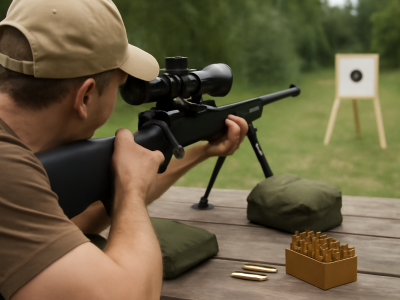
The weapon is stabilized using bags, a bipod, or a rest. The human factor is excluded.
Firing a series of shots
Three shots are fired using the same type of ammunition, at a specified distance, and without changing the aiming point. Rifled weapons are sighted in at a distance of 100 meters, while smoothbore weapons with slug ammunition are sighted in at a distance of 100 meters. 50-70 meters.
Hit Analysis
The average point of impact on the target is determined based on the results of several hits.
Sight Adjustment
When adjusting the front sight, the average point of impact is aligned with the aiming point. To do this, the front sight is moved in the direction of the average point of impact (API). That is, if the API is on the left, the front sight is moved to the left; if it is lower, the front sight is moved up, and so on. To adjust the rear sight, adjustments are made in the opposite direction: for example, if the average point of impact shifts to the right, the rear sight shifts to the left.
Firing Repeat Shots
After making adjustments, another series of shots is fired to verify the changes made. Shots and adjustments are repeated until the average point of impact coincides with the aiming point.
Precise execution of successive zeroing stages allows for high accuracy and the adjustment of various types of weapons, depending on the ammunition, ensuring predictable shots in any conditions.
The Role of Sights in Shooting Accuracy
In shooting accuracy, sights serve the following functions:
Magnification and detail. Optical sights allow you to magnify the target and see even small details, which is critical when shooting at long ranges.
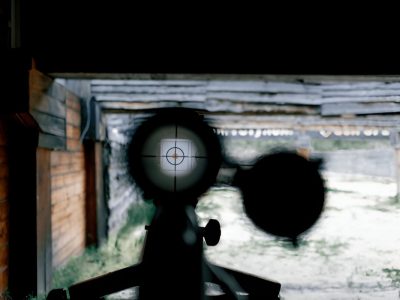
Aiming accuracy. The presence of a reticle (mark) in the sight provides an accurate reference for aiming the barrel, regardless of distance.
Compensation for external conditions. The adjustment mechanism allows for vertical and horizontal adjustments to the point of impact, taking into account trajectory, wind, and humidity.
Specificity considerations. Mechanical sights are used for short ranges, while optics are used for long ranges. Electronic sights allow you to save different zeroing profiles for different distances.
Typical Mistakes and How to Avoid Them
Sighting errors are common among both beginners and experienced shooters. The result is inaccurate results and the need for additional adjustments. We’ve compiled a list of the most common mistakes to help you minimize time and ammunition waste:
Incorrectly selected ammunition is one of the most common errors during sighting. Even small differences in bullet weight, propellant load, or shape will significantly impact shooting accuracy.
Use ammunition from the same batch and type! Never change ammunition during or after zeroing.
An unstable shooter’s position and support can lead to unpredictable zeroing results, as the weapon will shift during firing, increasing the spread of hits and distorting the accuracy of adjustments.
Incorrect sight adjustments will further distort the average point of impact. It’s important not to confuse the direction of adjustments and to pay attention to the markings on the scope turrets, making adjustments gradually, taking into account the division value.
Ignoring the weather (wind, lighting, temperature changes) is a mistake that will inevitably affect the bullet’s trajectory. We recommend performing zeroing only in stable conditions, taking into account crosswinds and the effect of temperature on bullet characteristics.
Issues with scope mounting and securing will distort the settings during shooting. As a result, the point of impact will shift, rendering zeroing useless. Check the scope’s mounts securely before and during shooting to eliminate any play.
A lack of understanding of how ballistics works—that is, the trajectory of bullets at different distances—is another cause of zeroing errors. To avoid errors, study the ballistic parameters of ammunition in advance and consider their flight path.
For zeroing to produce the desired results, it is important to prepare properly: learn the characteristics of the weapon and ammunition, proper body position and support, and learn how to make adjustments. Consistency and consistency during sighting guarantee a consistent and predictable result.
How often should you re-sight your gun?
The most important rule for maintaining your gun’s accuracy and reliability is regular sighting. It is important to take into account any, even minor, changes in use, ammunition, or accessories.
In other words, re-zeroing a weapon is mandatory if:
there is a change in the lot or type of ammunition;
a sight is being installed or replaced;
important events are planned, such as hunting or sporting competitions.
It should be noted that even a properly sighted weapon may deviate in practice due to changing weather conditions, terrain, damage, or loosening of fasteners. We recommend checking all settings immediately before use.
The best place for re-zeroing is a shooting range. If hot sighting isn’t possible, perform a cold sighting to align the sights with the point of impact.
Systematic training in a realistic environment helps identify weaknesses early, account for the impact of external conditions, and optimize the weapon for any task. This approach not only improves accuracy and shooting consistency, but also instills confidence in the shooter in every action—whether hunting, competition, or training.
More on this topic
26.11.2025
How to aim correctly at a shooting range
An accurate shot begins not with pulling the trigger, but with proper aim. Everything matters—grip, stance, breathing, and, most importantly, the ability to properly operate the sights. These skills must be constantly practiced. Only then will every bullet fly right to the center of the target.
I
02.12.2025
How active shooting headphones work and what to consider when choosing
During a gunshot, noise levels can exceed 140-160 dB, while explosions or heavy weapons create extremely strong acoustic loads that can damage the eardrum. Without proper protection, such sounds can cause microtrauma, decreased sensitivity, and irreversible hearing damage.
Personal protective equ
25.11.2025
Handling weapons: basic safety and shooting techniques
Using a firearm always carries risk. That's why anyone who picks up a pistol or shotgun must follow simple yet critical rules to avoid endangering themselves and others. This article summarizes the basic principles of firearms safety. These are skills every shooter should master until they become se
26.11.2025
How to aim correctly at a shooting range
An accurate shot begins not with pulling the trigger, but with proper aim. Everything matters—grip, stance, breathing, and, most importantly, the ability to properly operate the sights. These skills must be constantly practiced. Only then will every bullet fly right to the center of the target.
I
02.12.2025
How active shooting headphones work and what to consider when choosing
During a gunshot, noise levels can exceed 140-160 dB, while explosions or heavy weapons create extremely strong acoustic loads that can damage the eardrum. Without proper protection, such sounds can cause microtrauma, decreased sensitivity, and irreversible hearing damage.
Personal protective equ
25.11.2025
Handling weapons: basic safety and shooting techniques
Using a firearm always carries risk. That's why anyone who picks up a pistol or shotgun must follow simple yet critical rules to avoid endangering themselves and others. This article summarizes the basic principles of firearms safety. These are skills every shooter should master until they become se