Red Dot vs Holographic Sight: Differences and Which One to Choose
08.06.2026Author: Charles Darwin
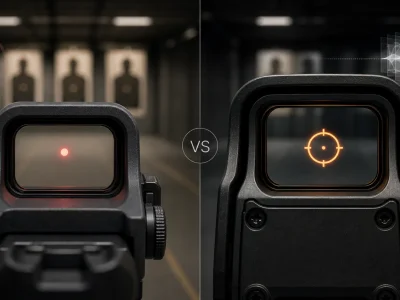
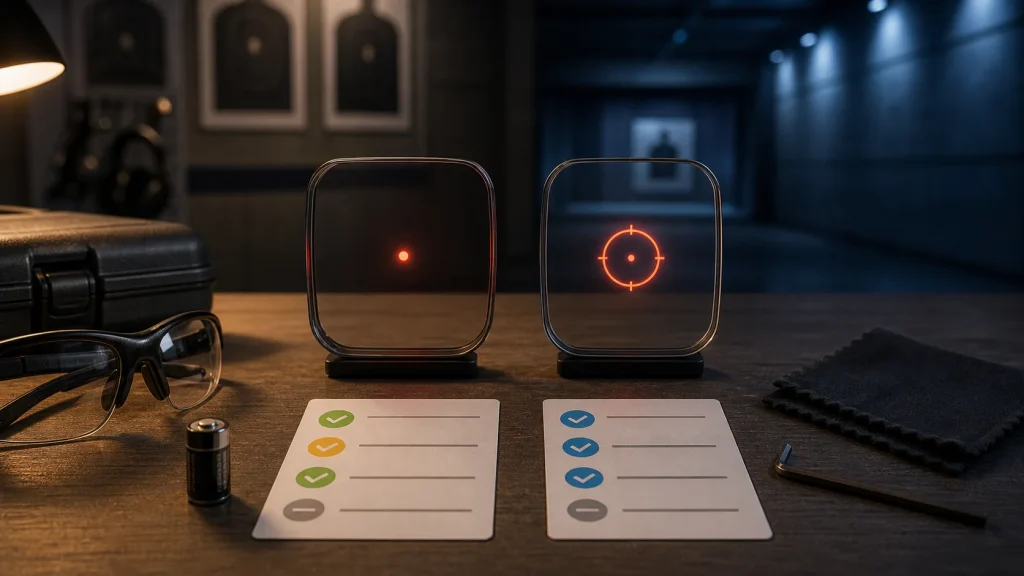
Shooters often face the dilemma of choosing a holographic or red dot sight. Both types of devices speed up aiming and improve shooting accuracy, but differ significantly in their operating principles, technical characteristics, and performance. In this article, we’ll explain what red dot and holographic sights are and how they differ from each other. We’ll also discuss which device is best for shooting range training, hunting, sport, and tactical use.
What is a red dot sight?
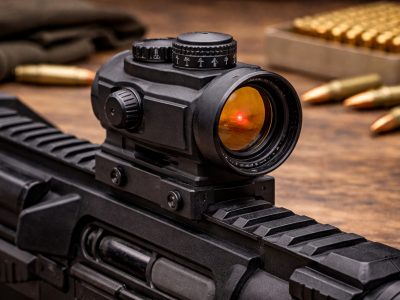
A red dot sight is an aiming device that projects a light mark (a dot, circle, or other symbol) onto the lens. The shooter simply aligns this mark with the target and fires. The main features of a red dot sight are:
High aiming speed. To aim, simply align the reticle with the target without having to align the front and rear sights.
Binocular aiming. Shooting is done with both eyes open, which provides a wide field of view and better awareness of the surroundings.
1x magnification. The collimator has no optical magnification, so the shooter sees the target at its true size without perspective distortion.
How a Red Dot Sight Works
A red dot sight operates quite simply. Inside its housing is a light source (usually an LED), which forms a reticle. This beam is reflected from a special lens with a translucent coating and projected into the shooter’s field of view as a dot, circle, or other symbol.
Depending on their design, red dot sights are classified as:
Open. They are compact, lightweight, and provide a wide field of view. However, the lack of a protective cover makes the LED and lens vulnerable to dust, dirt, rain, and snow.
Enclosed. These are designed as a sealed tube containing all the optical elements. These models are much better insulated from moisture, precipitation, and mechanical damage, but are heavier and larger.
What is a holographic sight?
A holographic sight is a modern electro-optical device in which the aiming mark is formed using a laser and a special holographic plate. During operation, the laser illuminates the reticle recorded on the hologram, resulting in a clear reticle visually positioned in front of the target. The reticle maintains its shape regardless of the viewing angle. Even if the shooter’s eye shifts relative to the sight’s central axis, it remains locked onto the target.
Main differences between a red dot sight and a holographic sight
Red dot and holographic sights perform the same function. They allow for quick target acquisition without the use of mechanical sights. However, there are a number of differences between these devices. Let’s look at the difference between a red dot sight and a holographic sight.
How the reticle is formed
In red dot sights, a built-in light-emitting diode (LED) emits a beam of light toward the lens. This lens has a special translucent dielectric coating that functions as a one-way mirror (reflecting the LED beam back to the shooter’s eye but remaining transparent for viewing the target). Since the lens is spherical, the reflected beams become parallel (collimated). The shooter sees the reflection of the light point on the glass and aligns it with the target.
Holographic sights use a laser diode instead of an LED. The reticle is pre-recorded as a hologram inside a special glass plate. The laser illuminates this hologram, reproducing its image in the shooter’s field of view. As a result, the human eye perceives the reticle not as a point on the glass, but as an image located directly in the target plane.
Parallax, Accuracy, and Performance at Different Distances
First, it’s worth understanding parallax. Simply put, it’s the effect of the reticle shifting relative to the target as the shooter’s eye position changes. Modern collimator models are virtually parallax-free at the manufacturer’s specified range, but at very close or significantly longer distances, some shift in the point of impact still occurs. In holographic sights, the reticle is formed using holographic technology, which minimizes the effects of parallax. This ensures that the reticle remains on target, no matter where the shooter’s eye moves within the viewing window.
Another important difference between a collimator sight and a holographic sight appears when using a magnifier (magnifier). In a collimator, a magnifer magnifies the entire image in the field of view, including the aiming point itself. If the mark has a large angular size, at significant distances it can partially or completely overlap the target. In a holographic sight, the center dot has a sub-angular size (less than 1 MOA). When a magnifer is connected, it does not visually increase, maintaining its original geometry.
As for working distances, red dot sights best reveal their potential at short and medium distances (up to 50-100 meters). Due to the absence of parallax, a large window and compatibility with magnifers, a holographic sight is a much more versatile tool. It allows you to effectively hit targets both at ultra-short distances and at medium distances up to 200–300 meters.
Autonomy and battery consumption
A modern LED collimator can operate on a single battery from 20,000 to 50,000 hours. The laser of the holographic sight consumes much more energy, so its battery lasts only 600–1000 hours of operation.
Price, reliability and service
Collimators are easy to manufacture, so there is a huge selection of models on the market to suit any budget — ranging from budget to premium. Holographic sights are produced by only a few brands in the world; they have a complex design and therefore are more expensive.
Behavior when the lens is dirty or damaged
Severe contamination, fogging or damage to the collimator glass can significantly impair the visibility of both the mark itself and the target. Holographic sights have a definite advantage in this aspect. Their reticle remains visible even if the viewing window is partially blocked or damaged.
Pros and cons of a red dot sight
Advantages of a collimator sight:
more affordable than holographic models;
simple and reliable design;
minimal power consumption and long battery life;
wide selection of models for different types of weapons;
compact size and light weight;
quick target acquisition;
the ability to shoot with both eyes open;
easy installation and setup.
Disadvantages of a red dot sight:
high sensitivity to dirt or damage;
budget models may exhibit noticeable parallax;
the quality and shape of the aiming dot depend on the manufacturer;
when using a magnifier, the aiming dot increases in size, which can make accurate shooting difficult. medium ranges.
Pros and cons of a holographic sight
Advantages of a holographic sight:
minimal parallax effect;
quick acquisition and tracking of moving targets;
more complex and informative reticles;
comfortable work with magnifiers;
high accuracy at short and medium ranges;
good visibility of the aiming mark even if the viewing window is partially dirty or damaged;
compatibility of many models with night vision devices;
stable operation in difficult tactical conditions.
Disadvantages of a holographic sight:
significantly higher cost Compared to most red dot sights;
Higher power consumption and shorter battery life;
More complex design and more expensive repairs if damaged;
Fewer models to choose from;
Larger weight and dimensions compared to compact red dot sights.
Which is better: a holographic or a red dot sight?
There is no definitive answer to this question. The choice between a holographic and a red dot sight always depends on the operating conditions of the device, the type of weapon, the budget, and the shooter’s goals.
For beginners and training at the shooting range
For beginning shooters, a red dot sight is the optimal choice. It is easy to learn, has a clear operating principle, is low-maintenance, and is significantly less expensive than holographic models. For instructor-led shooting lessons, range training, recreational shooting, and basic training, a high-quality red dot sight is more than sufficient.
For a carbine, dynamic shooting, and tactical tasks
If a weapon is used for practical shooting, dynamic exercises, or tactical training, holographic sights are often preferred. They are less sensitive to head position changes, provide more comfortable tracking of moving targets, and work effectively in conjunction with magnifiers. Furthermore, more complex reticles allow for more accurate shooting at medium ranges. At the same time, a high-quality red dot sight remains an excellent choice for a carbine, especially if compactness, light weight, and long battery life are priorities.
For a limited budget
If cost is a primary consideration, a red dot sight is a better choice. The market offers a wide variety of models in various price categories—from budget options for target practice to professional solutions.
For use with night vision and in challenging conditions
When the device will be used with night vision devices or in challenging conditions (rain, dust, smoke, low light), holographic sights are a good choice. Many of them have special modes for use with night vision devices, are less susceptible to contamination of the viewing window, and ensure the reticle is visible even in adverse conditions.
Comparison table: red dot vs. holographic sight
Criteria
Reflex sight
Holographic sight
Operating principle
Light reflection from the LED on the lens
Laser illumination of the hologram
Price
Below is a wide selection of budget models
Significantly higher due to more complex Designs
Battery
Up to 50,000 hours
600-1000 hours
Weight and dimensions
Lighter and more compact
Larger and heavier
Reticle
Simple dot or dot with a circle (2-4 MOA)
Complex reticles and reticle marks (
Parallax
Minimal, but may appear at certain distances
Virtually nonexistent
Shock resistance
Fails if lens is damaged
Works even if lens is damaged
FAQ: Red Dot and Holographic Sights
Can a holographic sight be considered a type of collimator?
Yes and no. From a practical standpoint, both sights are non-magnifying and perform the same task—they allow you to quickly aim at a target using a light reticle without using the front and rear sights. This is why holographic sights are often considered a separate type of collimator sight. However, technically, they are different devices.
Which sight is faster at close range?
At short ranges, the difference in speed between a high-quality collimator and a holographic sight is minimal. Both devices allow you to shoot with both eyes open and acquire a target almost instantly. However, in dynamic scenarios where it’s necessary to quickly switch fire between multiple targets or shoot while moving, holographic sights offer a slight advantage.
Which is better for a beginner: a red dot sight or a holographic sight?
For most beginning shooters, a red dot sight is the optimal choice. It’s simpler in design, easier to adjust, has a longer battery life, and is significantly less expensive. At the same time, its capabilities are quite sufficient for target practice, target shooting, and hunting.
Why are holographic sights usually more expensive?
This is due to the complexity of production. The laser emitter, the internal mirror system, and the hologram recording process itself require high-precision equipment and expensive materials.
More on this topic
11.03.2026
Why do you need a collimator and how does it work?
A red dot sight is one of the most popular optical devices used in modern shooting. Its main purpose is to help the shooter quickly acquire a target and execute an accurate shot without wasting time aligning the front and rear sights. This is why this device is widely used in sports, hunting, tactic
05.04.2026
Airgun Permits: Are They Required and How to Obtain One
Air pistols and rifles are often perceived as frivolous weapons, as there's a common misconception that purchasing them doesn't require a permit. However, in practice, things are not so clear-cut. In Ukraine, the circulation of such weapons is partially regulated by law, and in some cases, they are
25.05.2026
How to renew a firearms licence during martial law
The imposition of martial law and the onset of a full-scale invasion led to changes in Ukrainian legislation, particularly in the area of civilian firearms circulation. Until February 2022, owners of hunting, traumatic, and other civilian weapons were required to renew their permits for possession
11.03.2026
Why do you need a collimator and how does it work?
A red dot sight is one of the most popular optical devices used in modern shooting. Its main purpose is to help the shooter quickly acquire a target and execute an accurate shot without wasting time aligning the front and rear sights. This is why this device is widely used in sports, hunting, tactic
05.04.2026
Airgun Permits: Are They Required and How to Obtain One
Air pistols and rifles are often perceived as frivolous weapons, as there's a common misconception that purchasing them doesn't require a permit. However, in practice, things are not so clear-cut. In Ukraine, the circulation of such weapons is partially regulated by law, and in some cases, they are
25.05.2026
How to renew a firearms licence during martial law
The imposition of martial law and the onset of a full-scale invasion led to changes in Ukrainian legislation, particularly in the area of civilian firearms circulation. Until February 2022, owners of hunting, traumatic, and other civilian weapons were required to renew their permits for possession