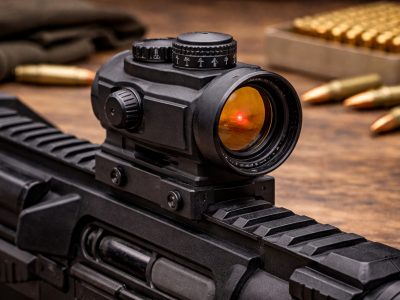
A red dot sight is one of the most popular optical devices used in modern shooting. Its main purpose is to help the shooter quickly acquire a target and execute an accurate shot without wasting time aligning the front and rear sights. This is why this device is widely used in sports, hunting, tactical training, and during training at shooting ranges.
In this article, we’ll look at how a red dot sight works, what it’s used for, the different types, and what to consider when choosing one.
What is a red dot sight used for?
A red dot sight is a device designed for quick and easy aiming of a weapon at a target. Its main advantage is that the shooter doesn’t need to align the front and rear sights, as with iron sights. Simply align the light mark with the target, and the shot can be taken.
A red dot sight consists of several main elements:
- housing;
- LED emitter;
- collimator lens;
- power supply;
- adjustment mechanisms;
- mount.
A red dot sight operates by projecting a light mark onto a special lens. Light from the LED reflects off its surface and enters the shooter’s eye as a sharp point. The light beams are collimated (aligned) so that the mark is visually located on the target. Thanks to this effect, the aiming dot remains in place even when the shooter slightly shifts their head. This is why with a red dot sight, there’s no need to search for the perfect center of the lens. Simply seeing the reticle and the target is enough.
Red dot sights are indispensable in situations that require high reaction times. They are used:
- during tactical shooting;
- in dynamic sports disciplines (IPSC, 3-Gun);
- for hunting moving game at short distances;
- during shooting range training;
- in situations where shooting is conducted from unusual positions or while moving.
At the same time, it’s important to understand that a red dot sight does not replace basic shooting skills. It simply simplifies the aiming process, allowing the shooter to react faster and utilize the weapon’s capabilities more effectively.
Why does a red dot sight shoot faster?
A red dot sight significantly reduces aiming time. This is primarily due to the fact that the shooter doesn’t need to align three points (the front sight, rear sight, and target) at once, as is the case with iron sights. With a red dot sight, it’s enough to simply align the light mark with the target. This makes aiming significantly faster, especially on the first shot.
Another important feature of a red dot sight is the ability to shoot with both eyes open. In this mode, the shooter has better visibility, finds the target faster, and moves the sight between different targets without delay. This is why such devices are widely used in dynamic disciplines where reaction speed is crucial.
A red dot sight is also less demanding on head position. With a slight eye movement, the reticle remains on the target, eliminating the need to waste time searching for the ideal aiming position. This is especially convenient when shooting from unusual positions or while moving. Furthermore, after firing, the shooter returns to the target more quickly, as the reticle immediately appears in their field of view.
Types of Red Dot Sights
By design, collimator sights are divided into open and closed. Both types operate on the same principle, but differ in housing design, protection level, and area of application.
Open Collimator
An open, or reflex, collimator has a very simple design. Its main elements are a translucent lens, an LED emitter, and a small optical module that forms the aiming reticle. Unlike closed models, it does not have a tubular housing, making it more compact and lightweight.
The main advantage of an open collimator is a wide field of view and high target acquisition speed. Thanks to its minimal dimensions, the shooter finds the target faster and more easily monitors the surrounding area. However, this design also has certain disadvantages. Because they lack a housing, open collimators are less protected from dust, dirt, rain, and mechanical impact.
Closed Collimator
A closed collimator is a sight in which all optical elements are housed within a tubular housing. This design protects the device from moisture, dust, impacts, temperature changes, and other external influences.
Due to the housing, closed collimators are considered more durable and versatile. They are well suited for tactical shooting, hunting, and use in difficult conditions. However, devices of this type also have certain disadvantages. The main ones are their increased weight and slightly narrower field of view compared to open models. However, for many shooters, these features are not critical.
Aiming Technique and MOA
When using a red dot sight, the shooter focuses on the aiming mark— A light dot or other marker projected onto the lens. Its size can vary and is measured in MOA (Minute of Angle). This angular value indicates how much area on the target the aiming dot covers at a given distance.
In simpler terms, a 1 MOA red dot covers approximately 3 cm at 100 meters, 2 MOA covers approximately 6 cm, and 4 MOA covers approximately 12 cm at the same distance. The higher the MOA, the more area on the target the aiming dot covers.
A 1-2 MOA red dot allows for more precise aiming control because it covers a smaller portion of the target. At the same time, such a dot is harder to notice, especially when shooting on the move or in low light. A larger reticle (3-4 MOA) is clearly visible in the field of view, making it much easier to quickly acquire a target.
For general-purpose use, many shooters choose red dot sights with a 2-3 MOA reticle. This reticle is clearly visible when aiming, doesn’t obscure the target, and allows for sufficient accuracy at short and medium ranges.
Pros and Cons of a Red Dot Sight
Like any equipment, a red dot sight has its pros and cons. Its main advantages include:
- quick target acquisition;
- the ability to shoot with both eyes open;
- less dependent on head position;
- ease of use;
- compact size and light weight;
- minimal parallax effect at short and medium ranges.
Among the main disadvantages of collimators are:
- dependence on a power source;
- lack of optical zoom;
- the sight only shows the direction of the shot, but does not take into account the ballistics of the bullet;
- the size of the aiming dot may overlap part of the target if it is chosen incorrectly.
A collimator sight performs best when shooting at short and medium ranges. At ranges where reaction speed is crucial. When used correctly, it significantly simplifies weapon handling and helps the shooter act faster and more confidently.
How to choose a red dot sight for yourself?
When choosing a red dot sight, it’s worth considering several key parameters:
- Construction type. Open red dots are lighter and provide a wider field of view. They are well suited for dynamic shooting. Closed models have a tubular body. They are better protected from dust, moisture, and mechanical damage.
- Reticle size. A small reticle (1-2 MOA) allows for more precise aiming, while a larger reticle (3-4 MOA) is more visible in the field of view and is easier for quick target acquisition. A red dot sight with a 2-3 MOA reticle is considered a universal option.
- Mounting Type. For secure installation, the sight must fit the weapon’s rail. The most common options are Picatinny or Weaver.
- Power and Battery Life. Most red dot sights are battery-powered. It’s worth paying attention to the device’s battery life. Some models have automatic shut-off or a motion sensor to conserve battery life.
- Brightness Adjustment. The ability to change the reticle brightness allows you to adjust the sight to different lighting conditions.
It’s best to test a red dot sight before purchasing it to determine how it meets your needs and objectives. This can be done at a shooting range or a shooting gallery. There you will be able not only to evaluate the sight, but also to practice basic shooting skills, learn the rules of handling weapons, learn how to aim correctly and improve the accuracy of your shots.