Loading 16-Gauge Cartridges: Materials, Techniques, and Safety Rules
05.05.2026Author: Charles Darwin
Independently assembling ammunition (reloading) is more than just a way to save money or pay tribute to classic traditions. Above all, it is a tool for precisely tuning ammunition for a specific weapon, distance, and shooting task.
Unlike factory ammunition with standardized parameters, hand assembly allows for control over every element. The shooter can independently select the case type, primer, propellant powder dose, cannon system, and pellet weight. These factors influence shot stability, dispersion density, and the overall effectiveness of the ammunition.
At the same time, reloading 16-gauge ammunition requires strict adherence to technology and safety regulations. Even minor errors in dispensing or component assembly can affect shot quality, weapon performance, and shooter safety.
In this article, we will discuss how to properly load 16-gauge ammunition to achieve consistent and predictable results. We’ll also explain the components and equipment used.
Choosing Components and Materials for 16-gauge
To assemble 16-gauge cartridges yourself, you’ll need the following basic components:
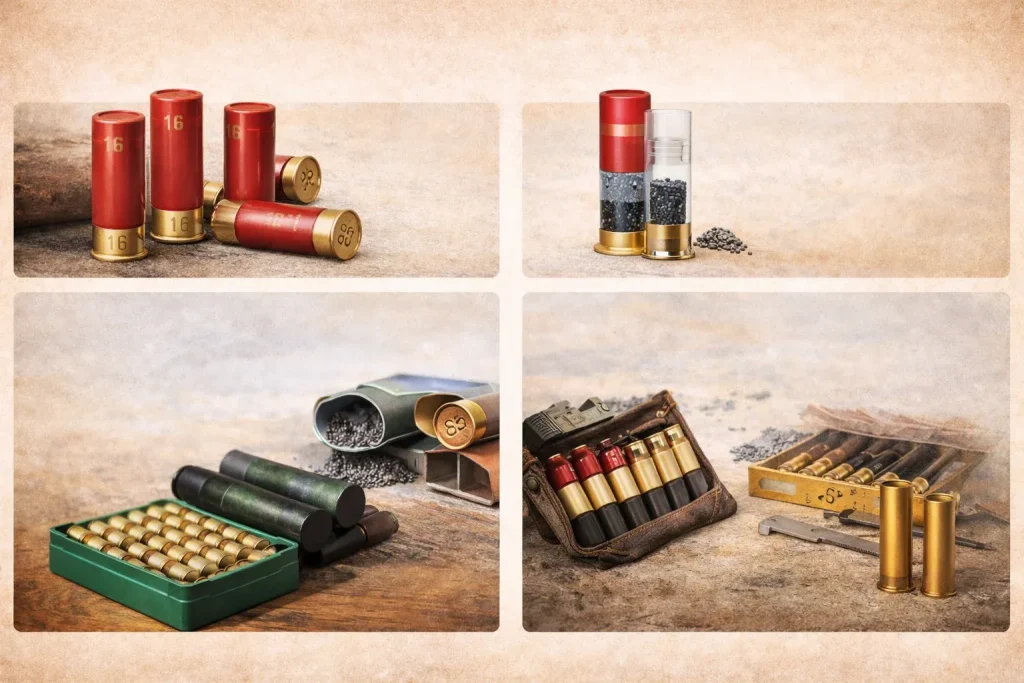
Cases (plastic or brass). These serve as the housing for housing and protecting all components of a 16-gauge cartridge.
Blasting caps. These are selected according to the cartridge type and are responsible for igniting the propellant charge.
Gunpowder. The grade and weight of this substance are calculated based on the weight of the projectile and its required muzzle velocity.
Wads (fiber, cork, wood). These provide a gas seal and cushion the propellant charge during firing.
Gaskets (cardboard or plastic). They are installed between the powder and the wad, as well as under the projectile, to ensure proper pressure distribution.
Sealing devices. Cardboard plugs or special star-shaped crimps that secure the contents of a 16-gauge cartridge case and protect it from moisture.
The choice of ammunition should be considered separately. Bullets are used to ensure maximum penetration, while shot and buckshot are used to create a wide killing zone.
Brass and Plastic Cases: Features and Advantages
For the manufacture of 16-gauge cartridges, you can choose between brass or plastic cases. Each option has its own characteristics.
Brass cases are a classic solution for 16-gauge cartridges with a long service life. They withstand repeated reloading, withstand mechanical stress well, and are not subject to deformation when used properly. Thanks to their rigid walls, brass retains its shape well, which positively impacts the seating of components during repeated reloading. However, loading cartridges into brass cases has its own unique challenges. They are heavier, require more precise component selection (especially primers and wads), and the sealing process is typically accomplished with gaskets rather than a star-shaped seal. Brass cases also require more careful maintenance, including regular cleaning and inspection after each use.
Plastic cases are the modern standard for 16-gauge cartridges. They are more affordable, corrosion-resistant, lighter, and significantly easier to use. These cartridges are compatible with container wads, are easy to seal, and require no complex reloading operations. Their drawbacks include a shorter lifespan. After several reloading cycles, the plastic gradually loses rigidity and deforms, which negatively impacts the cartridge’s quality.
Selection of Primers, Powder, and Shot Types
The effectiveness and stability of a 16-gauge cartridge are determined by the coordinated operation of three elements: the primer, powder, and projectile. These elements are selected not individually, but as a unified system for a specific cartridge case, loading system, and propellant weight.
The primer-detonator is responsible for initiating the shot, so it is selected in accordance with the cartridge case type and the powder used. Its power must be balanced. An overly powerful primer causes a dangerous pressure spike (detonation), while one that’s underpowered leads to unstable muzzle velocity. This is why it’s important to use compatible components and adhere to proven loading schemes.
The propellant powder determines the pressure buildup in the barrel and the final energy of the shot. For 16-gauge, propellant selection is critical due to the smaller combustion chamber volume compared to 12-gauge. Lighter loads require propellants with a high deflagration velocity, while heavier loads should use propellants with a low ignition velocity to smoothly increase the projectile’s velocity as it travels down the barrel. The propellant powder charge must be measured with an accuracy of 0.01 g in accordance with the loading tables, as even a slight deviation can cause damage to the weapon.
Ammunition (shot/buckshot) is selected based on the required range and target characteristics:
#7-#12 shot provides maximum shot density, making it ideal for clay pigeon shooting and hunting small game birds;
#4-#6 shot has an optimal ratio between the number of projectiles and their kinetic energy;
#3-#1 shot and buckshot are used for shooting at large targets, where stopping power is crucial.
Equipment required for high-quality assembly Cartridges
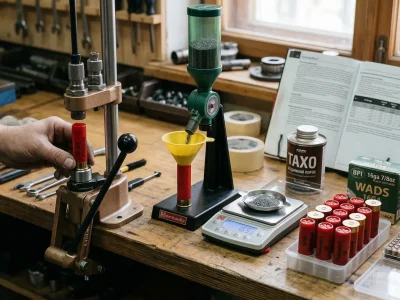
Before you begin making 16-gauge cartridges, you need to prepare a basic set of tools. The following are used during reloading:
a cartridge case stand for holding the cartridges in place during reloading;
a funnel for pouring powder and shot into the cartridge case;
a wad chuck for loading wads into the cartridge case;
a scale for accurately dosing powder and shot;
containers for pre-dosing the components;
a device for extracting and installing capsules;
a case crimping machine.
Particular attention should be paid to the scales. The best solution is high-precision laboratory models, which allow for precise load control with minimal error.
How to Properly Load 16-Gauge Ammunition: A Step-by-Step Guide
Making 16-gauge ammo is a sequential process, where precision is essential at every step. Let’s look at the algorithm for creating high-quality ammunition.
Case Preparation and Calibration Before Loading
Before starting work, inspect the cases. Avoid cases with cracks, damaged edges, or other defects. Particular attention should be paid to reusable cases.
Also, keep in mind that after firing, the metal flange and base of the case expand to conform to the chamber shape of the specific shotgun. To ensure universal compatibility and trouble-free operation, the case must be calibrated. To do this, pass the case through a calibrating ring or a special press. This restores its factory parameters, ensuring free entry into the chamber and extraction.
Propellant Charge Dosage and Wad Handling
Use a scale to measure the exact amount of powder charge. This is selected in accordance with the powder manufacturer’s recommendations and loading tables. Even a slight excess of the permissible weight can lead to negative consequences.
After loading the powder into the cartridge case, a powder gasket or wad container is installed. The main goal at this stage is to ensure a high-quality gas seal. The wads are tightly packed using a tamping tool. It is important to maintain uniform clamping pressure, as the packing density directly affects the combustion rate of the powder and the muzzle velocity of the bullet or shot.
Installing the top gasket and closing the cartridge case
Pellets, buckshot, or a bullet are poured into the prepared wad system. If the classic design without a container is used, a thin powder gasket is placed on top. Next, the 16-gauge cartridge case is closed using a crimping method or a “star” (for plastic cartridges). It is important that the closure is tight and securely holds the contents.
After assembly, mark the 16-gauge cartridges with the pellet number, load type, or other parameters. This allows for quick identification of the ammunition during use.
Features of Loading Cartridges for Different Types of Hunting
As noted above, the main advantage of assembling 16-gauge cartridges yourself is the ability to precisely adjust the ammunition for a specific task. This is especially important for hunting, as different types of hunting require adjustments to the cartridge parameters for maximum effectiveness:
Small game hunting (snipe, woodcock, quail). In this case, the priority is a wide and uniform shot pattern at short ranges. The optimal choice is #7-9 pellets, which form a dense target coverage. It is advisable to select a powder charge at the lower end of the recommended range to minimize damage to game.
Duck, black grouse, and pigeon hunting. These types of hunts typically take place at medium ranges (30-40 meters) and often in high humidity. The optimal choice is #4-6 shot, which provides a balance between dispersion density and lethal energy. It is advisable to use plastic cartridge cases, which protect the shot from deformation and improve accuracy. The powder charge is selected within the standard recommendations for a given load type.
Large game hunting (wild boar, deer). In this case, bullets or buckshot with a diameter of approximately 6.5-8.0 mm are used. The main goal is to ensure maximum stopping power and shot stability. Special wads or containers are used for bullets, which center the projectile in the barrel. When using buckshot, it is advisable to stack it in an orderly manner (in rows), as this has a positive effect on the accuracy and predictability of dispersion.
Safety Precautions When Working with Gunpowder and Explosives
Reassembling 16-gauge cartridges yourself is a process that requires extreme concentration and strict discipline. Gunpowder and primers are flammable and explosive substances, so any carelessness can result in injury to the shooter or damage to the weapon. Therefore, the following rules must be observed when reloading:
Your work area must be clean and free of foreign objects. Smoking, using open flames, or turning on heating devices near the gunpowder are strictly prohibited.
Only one can of the gunpowder you are using at a time should be on your work bench. Never mix different brands or types of gunpowder. Their burn rates and peak pressures can vary dramatically.
Use only properly calibrated electronic or pharmacy scales. Never exceed the manufacturer’s maximum load ratings on the packaging.
Do not reload 16-gauge cartridges while tired, under the influence of medication, or in the presence of people who might distract you. Careless errors are the most common cause of barrel failure.
Powder and primers should be stored in their original packaging in a dry, dark place, out of the reach of children, and away from heat sources.
Conclusion: How to Achieve Consistency and Quality of Shot
Assembling 16-gauge cartridges yourself offers an invaluable advantage—the ability to create ammunition that is perfectly matched to your gun, ensuring perfect grouping and sharpness of shot. To achieve this:
Calibrate shells before reuse;
Use high-quality tools for dispensing and assembling ammunition;
Follow proven reloading schedules and component manufacturer recommendations;
Use identical components within a single batch of ammunition;
Precisely control the amount of powder and projectile weight;
Ensure a tight and even fit of the tubing system;
Select shotshells or slugs depending on the distance and type of target;
Check the finished ammunition for quality after assembly;
Test the ammunition at the shooting range and adjust the recipe to your firearm;
Do not violate safety regulations at any stage of the reloading process.
Of course, even a perfectly assembled cartridge A 16-gauge shotgun is only part of the equation. Accurate shooting requires regular practice and a thorough understanding of aiming principles. You can hone your shooting skills at our shooting range in Lviv. Here you’ll find modern infrastructure, high-quality equipment, and experienced instructors who will teach you how to shoot straight to the target.
More on this topic
05.02.2026
How to choose a shotgun for a beginner: an overview of the main criteria
A shotgun is one of the most popular types of civilian firearms. It is used for shooting range training, sports, hunting, and, in some cases, for self-defense. However, for a beginner, choosing their first shotgun can be more difficult than it seems at first glance. The same model may be comfortable
28.03.2026
How a Gun Silencer Works: An Overview of Types and Impact on Firing
A gunshot is a complex process that, in a split second, involves an explosion and rapid expansion of gases, creating that loud sound we associate with gunfire. But what if this sound could be significantly reduced? This is indeed possible thanks to a suppressor (sound moderator). This device alters
11.12.2025
Gun safe: how to choose a reliable option and install it correctly
Owning a gun always comes with a heightened sense of responsibility. That's why the state regulates not only the acquisition and use of guns, but also storage conditions. Compliance with these rules is mandatory for every gun owner, as violating them can lead to serious legal consequences. In this a
05.02.2026
How to choose a shotgun for a beginner: an overview of the main criteria
A shotgun is one of the most popular types of civilian firearms. It is used for shooting range training, sports, hunting, and, in some cases, for self-defense. However, for a beginner, choosing their first shotgun can be more difficult than it seems at first glance. The same model may be comfortable
28.03.2026
How a Gun Silencer Works: An Overview of Types and Impact on Firing
A gunshot is a complex process that, in a split second, involves an explosion and rapid expansion of gases, creating that loud sound we associate with gunfire. But what if this sound could be significantly reduced? This is indeed possible thanks to a suppressor (sound moderator). This device alters
11.12.2025
Gun safe: how to choose a reliable option and install it correctly
Owning a gun always comes with a heightened sense of responsibility. That's why the state regulates not only the acquisition and use of guns, but also storage conditions. Compliance with these rules is mandatory for every gun owner, as violating them can lead to serious legal consequences. In this a